


Blog
Women’s Parkas 2026: What to Check Before You Buy

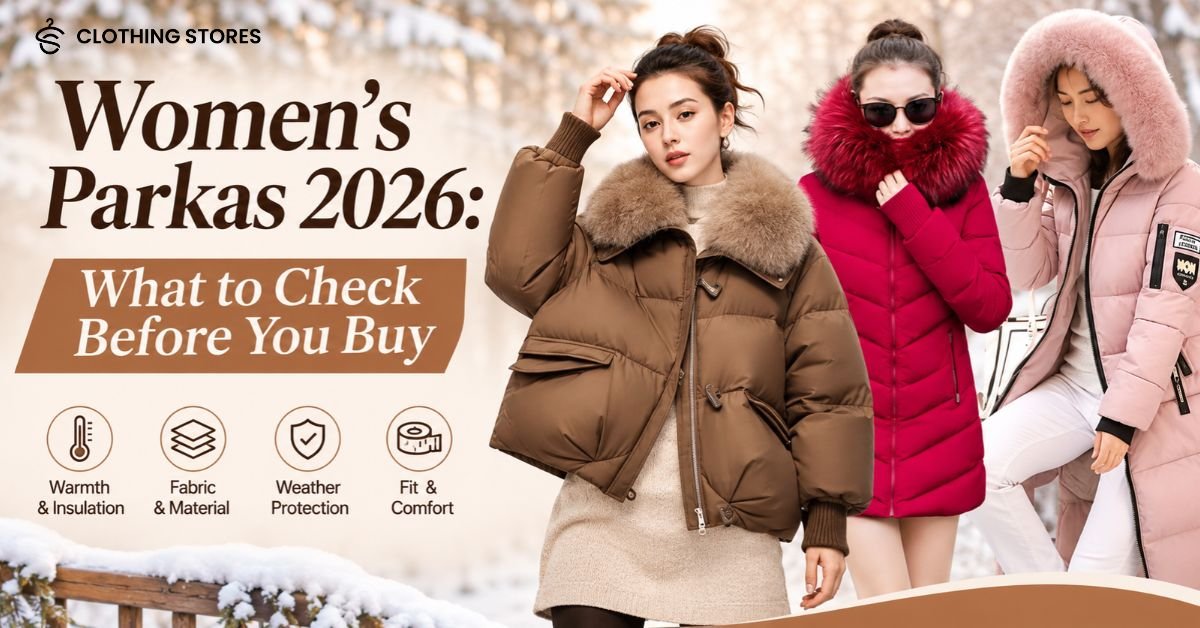
A parka is the coat you buy for the worst days of winter. The ones with sideways snow, wind that stings your face and sidewalks you’d rather not stand on. Knowing how to choose a women’s parka saves you from two problems: freezing in a coat that looked warm online or overheating in one built for the Arctic. Below you’ll find what makes a parka different, a seven-point buying checklist, what to know about fur and faux fur trim and five parkas worth a look. Browse our women’s parkas as you read.
Quick Answer at a Glance
Pick a parka that covers your hips or more, has a hood that fits over a hat, blocks wind and keeps light snow out. Leave room for a sweater. Check the fiber and fur labels on the product page.
| Feature | What to look for | Why it matters |
|---|---|---|
| Length | Hip to knee | Covers your core and upper legs |
| Insulation | Down for dry cold, synthetic for wet cold | Matches your weather |
| Shell | Water-resistant at minimum | Snow melts on the fabric |
| Hood | Lined, fits over a hat, trimmed edge | Blocks wind around your face |
| Cuffs and closure | Inner cuffs, zipper with a storm flap | Stops drafts |
| Fit | Zips easily over a sweater | Squashed filling loses warmth |
What Makes a Parka a Parka?
Every parka is a winter coat. Not every winter coat is a parka. A parka is longer than a typical jacket and almost always has a hood. Its outer shell is usually smooth instead of quilted, which helps it shed snow and block wind.
Puffers show their stitched sections on the outside. Parkas often hide the insulation behind a plain shell. That makes them look a little sleeker and handle harsh weather better. If you’re still choosing between the two, our cropped vs long puffer comparison covers puffers in detail.
How to Choose a Women’s Parka: The Seven-Point Checklist
1. Length
Hip length is the minimum for real cold. Mid-thigh is the sweet spot for most cities because it covers your hips without getting in the way on stairs. Knee length suits long waits outdoors. Short parkas are easier to drive in but leave your legs exposed.
2. Insulation
Down traps a lot of warm air for its weight and suits dry cold. Synthetic fill keeps more warmth when it gets wet. Fleece linings add softness. Check the product page to see what’s inside each parka.
3. The shell
Water-resistant: the fabric sheds light rain and snow for a while. Waterproof: the fabric and sealed seams keep water out for long periods. For most US cities, water-resistant is enough. If you live somewhere with wet, heavy snow, look for a parka described as waterproof.
4. The hood
Try it with a hat on. A good hood covers your ears and forehead without blocking your side view when you turn your head. A trimmed edge breaks up wind around your face. A removable or adjustable hood adds flexibility for milder days.
5. Cuffs and closures
Knit or elastic inner cuffs stop cold air from running up your sleeves. A zipper with a snap or Velcro storm flap blocks wind better than a zipper alone. Two-way zippers help you sit and climb stairs in longer parkas.
6. Pockets
Lined hand pockets warm your fingers when you forget gloves. An inside pocket keeps your phone warm so the battery lasts longer in cold weather. Count the pockets before you buy.
7. Fit
Wear your thickest sweater when you try it on. The parka should zip without pulling. Your arms should lift without the hem riding up a lot. Too tight squashes the filling. Too big lets cold air in at the hem. Check the size chart on the product page since cuts vary.
Fur and Faux Fur Trim: What to Know
Many parkas have trim around the hood. It looks cozy and it also helps break up wind before it hits your face. Some trim is real fur. Most is faux.
In the US, the FTC enforces the Fur Products Labeling Act. Real fur on clothing must be labeled with the animal’s name. Imported fur must also show its country of origin on the label, written out as the fur’s origin. If you want to avoid real fur, read the product description and the label closely. Faux fur trim is easier to clean and usually costs less. A removable trim makes washing the parka much simpler.
Five Parkas Worth a Look
Every pick below comes from the Clothing Stores catalog. Prices were checked in November 2026 and can change during sales. Check each page.
Recommended products
-

Short Parka Coat for Women, Padded Winter Jacket with Lapel Collar
$80.00 -
Faux Fur Padded Parka for Women
Original price was: $121.44.$96.08Current price is: $96.08. -
Fleece Lined Hooded Down Parka for Women
Original price was: $203.56.$157.67Current price is: $157.67. -
Fur Hood Parka for Women
Original price was: $155.86.$121.90Current price is: $121.90. -
Fur Lined Hooded Parka for Women
Original price was: $238.92.$184.19Current price is: $184.19.


The faux fur padded parka
A padded parka with faux fur trim at a friendly price. The faux fur padded parka was listed at $76.08, the lowest price in this list.
The short parka
For drivers and mild cold. The short parka coat has a lapel collar and was listed at $92.53.
The fur hood parka
A longer zip-up shape with a trimmed hood for windy days. The fur hood parka was listed at $101.90.
The fleece lined hooded down parka
Down filling plus a soft fleece lining for extra warmth next to the body. The fleece lined hooded down parka was listed at $137.67.
The fur lined hooded parka
A lined hood and plush trim for the coldest mornings. The fur lined hooded parka was listed at $164.19, the highest price on this list. It suits anyone who spends long stretches outside. Check the product page for the trim material.
| Parka | Key feature | Price (Nov 2026) | Best for |
|---|---|---|---|
| Faux fur padded parka | Padded, faux fur trim | $76.08 | Budget winter coat |
| Short parka coat | Short, lapel collar | $92.53 | Driving, mild cold |
| Fur hood parka | Zip-up, trimmed hood | $101.90 | Wind and snow |
| Fleece lined hooded down parka | Down plus fleece lining | $137.67 | Very cold, dry days |
| Fur lined hooded parka | Lined hood, plush trim | $164.19 | Coldest mornings |
Match the Parka to Your Winter
Snowy Midwest and Northeast cities call for a mid-thigh or knee-length parka with a trimmed hood. Mountain towns with dry, deep cold suit down-filled styles. Wet coastal winters favor a water-resistant shell and synthetic fill. In the South or other mild places, a short parka is often plenty for the few cold weeks each year.
Say you live in Detroit and walk your dog twice a day. Mornings often feel much colder with the wind. A mid-thigh hooded parka with fleece lining keeps you warm on those walks. Lined pockets hold your hands and the leash. The hood stays up the whole time without blocking your view of traffic. You come home warm instead of counting down the minutes.
Comparing parkas with wool coats and other outerwear? Read our winter coat buying notes for a full side-by-side.
What to Wear Under a Parka
A parka does most of the work. What’s underneath decides whether you stay comfortable or end up sweaty and then cold.
Start with a thin base layer that pulls moisture away from your skin. Add one warm mid layer like a sweater or a fleece. Stop there for most city days. Piling on two thick sweaters under a well-filled parka often leads to sweating on the walk. That damp layer then chills you once you stand still at a crosswalk.
Unzip a little when you step onto a heated bus or into a store. Letting heat out early keeps you dry. Gloves, a hat and a scarf finish the system. They’re easy to remove and add a lot of warmth for very little bulk.
Parka Care Basics
Follow the care label. Most clothing sold in the US has to carry one under the FTC Care Labeling Rule. Remove faux fur trim before washing if you can. Wash the parka only when it’s dirty, on a gentle cycle if the label allows. Dry it fully so the filling doesn’t clump. Brush faux fur gently with a wide-tooth comb to fluff it back up. Store the parka on a sturdy hanger in a breathable bag.
How we picked: every parka in this article came from the live Clothing Stores catalog. We used each product page for the style details and price.
About the Author
Clothing Stores Style Team: the team behind Clothing Stores, a US online store for women’s dresses, coats, sweaters and everyday wear. We pick and describe every piece in our catalog with fit, fabric and season in mind.
FAQs About How to choose a women’s parka
Often, yes. Parkas are usually longer, with a hood and a shell built to block wind and snow. That extra coverage keeps more heat in. A long, well-filled puffer can match a parka on dry, still days. In wind and wet snow, a parka’s smooth shell usually wins. Your climate decides which matters more.
Long parkas can feel bulky behind the wheel and push seat belts away from your body. A short or hip-length parka is more comfortable in a car. If you need a long one for walking, choose a two-way zipper. Unzip the bottom before you sit so the coat doesn’t bunch up around your hips.
Yes. Many people wear a parka for the commute and hang it up at work. Pick a neutral color like black, navy, olive or camel.
Remove the trim if it detaches. Spot-clean with cool water and a drop of mild soap on a damp cloth. Don’t scrub. Let it air dry away from heat. Once dry, brush gently with a wide-tooth comb to separate the fibers. Avoid the dryer since heat can melt or mat synthetic fur.
Replace it when the filling stays flat after fluffing, the shell lets in wind or water or the zipper keeps failing. Small fixes like a new zipper pull can extend its life. A parka that no longer keeps you warm on your usual walk has done its job. It’s time for a new one.
Choose Your Parka With Confidence
Now you know how to choose a women’s parka that fits your winter. Check the length, the filling and the shell. Try the hood with a hat. Size for a sweater and read the labels for fiber and fur. Browse parkas at Clothing Stores to find yours. Questions about sizing or an order?
- Email support@clothingstores.us
- +1 (208) 590-7024